
August 19th, 2026
As Wisconsin heads into the November election, inflation and the cost of living top the list of voters’ concerns. For Wisconsin families with young children, childcare accounts for an increasingly large share of the household budget. According to Wisconsin’s Department of Children and Families, the average annual cost for infant care is $17,400 in center-based programs, and $13,000 for family-based programs. That means center-based infant care costs 22% of what a typical Wisconsin household earns. To make matters worse, childcare costs in Wisconsin are rising faster than inflation. Any way you cut it, rising childcare costs are a major driver of the cost-of-living pressures facing Wisconsin families.
Nearly all agree that childcare should be affordable for families, but there is a divergence in what policymakers propose we do about it. One camp thinks that continually throwing more money at the problem through subsidies is the answer. Look to Minnesota, where Governor Tim Walz signed a $1.3 billion childcare package into law. It included monthly payments to childcare providers to increase staff pay. On top of that, the federal government already subsidizes childcare for eligible families through the Child Care and Development Fund, which states administer.
So, what happened? Minnesota’s childcare system gained national attention for fraud. The state’s own Legislative Auditor found that Minnesota’s controls were insufficient to effectively detect fraud in the Child Care Assistance Program—the state’s childcare subsidy program. And more relevant to affordability: Minnesota now has the 3rd most expensive infant care in the country at $23,725 a year, and only 6% of Minnesota families can afford infant care at the federal standard of 7% of household income. The subsidies did not make care affordable.
The same is true of costs in Wisconsin. Wisconsin childcare providers have received significant subsidization from the state and federal government, yet the childcare affordability issue persists and prices have only gone up. The reason isn’t hard to see—a subsidy helps a family pay a bill, but it does not create a single new childcare seat. More money chasing the same seats pushes prices up, and it takes pressure off providers to bring costs down.
Before policymakers can solve the affordability problem, they first must recognize one of the primary reasons why there is a childcare supply shortage in our state—too much red tape.
Wisconsin Ranks Near Bottom in Childcare Freedom
According to the Archbridge Institute’s 2026 Childcare Regulations Index, Wisconsin ranks 43rd out of 50 states for childcare freedom—placing it in the most heavily regulated group nationally and in last place in the Midwest. The Index ranks states across the dimensions of maximum group size, child-to-staff ratio requirements, required annual number of training hours, and minimum education requirements for staff members.
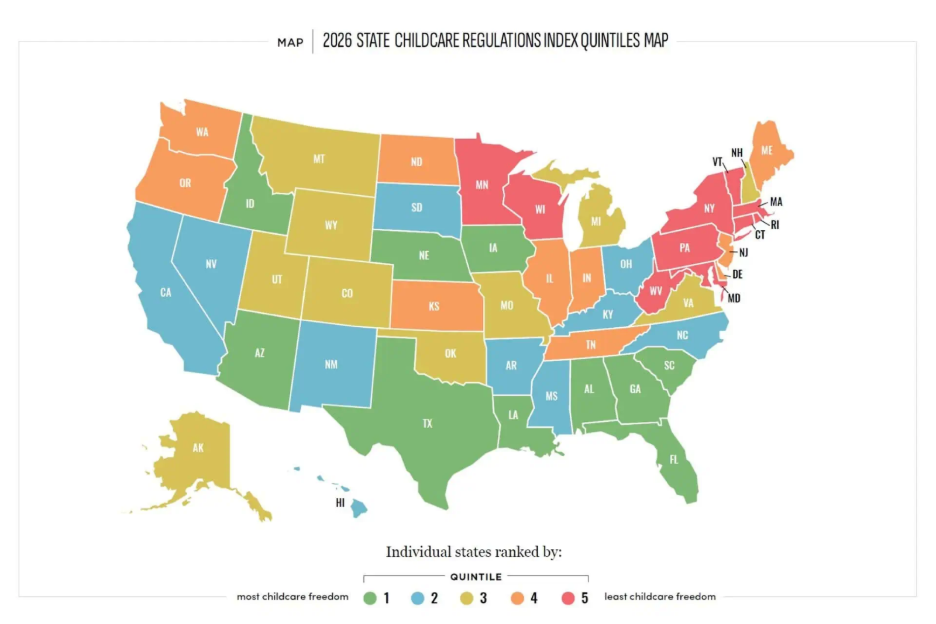
Wisconsin ranks 43rd of 50 states for childcare freedom, last in the Midwest. Neighboring Iowa ranks 7th. Source: Archbridge Institute, 2026 State Childcare Regulations Index.
If Wisconsin is going to heavily regulate childcare centers, one would hope that regulation would at least lead to improved quality of care. After all, the goal of childcare regulation is to ensure quality of care and to keep children safe. However, according to a 2025 WILL report on childcare reforms—conducted with the Archbridge Institute and the Knee Regulatory Research Center—the evidence doesn’t point to such a payoff. The report shows that Wisconsin rules have led to higher costs and fewer childcare providers, without the upside of quality improvement. Compared to neighboring Iowa, which ranks 7th nationally for childcare freedom, Wisconsin reported roughly six times as many total complaints, a gap that persists even accounting for Wisconsin’s larger population. At the same time, Iowa families pay significantly less for childcare.
The Solutions Are in Plain Sight
When burdensome government rules don’t result in quality improvements, it’s time to question the rules—and change them. In the 2025 report, WILL recommended multiple deregulatory solutions to increase childcare supply and improve affordability. Fortunately, some solutions are currently in the process of implementation, but there is still much more to do to face the problem head-on.
Raise the Child-to-Staff Ratio Permanently: Wisconsin should make its current, higher child-to-staff ratios permanent, and then responsibly raise them even more. One influential study estimates that increasing the ratio of infants per staff member by one infant would reduce the cost of childcare by 9 to 20%. Ohio, the highest-ranked state in the region for child-to-staff ratios, lets one worker care for six infants between 12 and 18 months old, whereas Wisconsin allows one worker to care for only four infants in that age range. Georgia, which has the least restrictive ratios in the country, goes further still—once a one-year-old is walking, one worker may care for eight children. Wisconsin should follow the lead of these other states.
This is not a hypothetical ask. 2025 Wisconsin Act 15, the state’s biennial budget bill, authorized a pilot program to temporarily raise the ratio for children 18 months to 2½ years old to one teacher per seven children. Before Act 15, the rule was one teacher per four children up to age 2, and one per six from age 2 to 2½. But the law put an expiration date on the change. On August 1, 2027, the older, stricter ratios will come back automatically unless the Legislature acts first.
Lock In the Larger Maximum Group Sizes: Wisconsin should also increase maximum group sizes permanently. Maximum group sizes are smallest for infants, and as children age, the groups can be larger. Here again, Act 15 took one positive step forward by raising the maximum group size for children 18 months to 2½ years to 14 children. This too is only a temporary pilot program. Before Act 15, that age range was split in two, with a limit of eight children under age 2 and 12 children from age 2 to 2½. The new cap matches Minnesota for children in this age range, and it narrows the gap with Illinois, where a group of two-year-olds can reach 16. But this cap expires on the same day as the ratio change. On August 1, 2027, those old limits come back unless lawmakers make the change permanent. In that case, a room of 20-month-olds would drop from 14 children to eight. Moving forward, Wisconsin should thoughtfully increase maximum group sizes across age ranges to align with neighboring states.
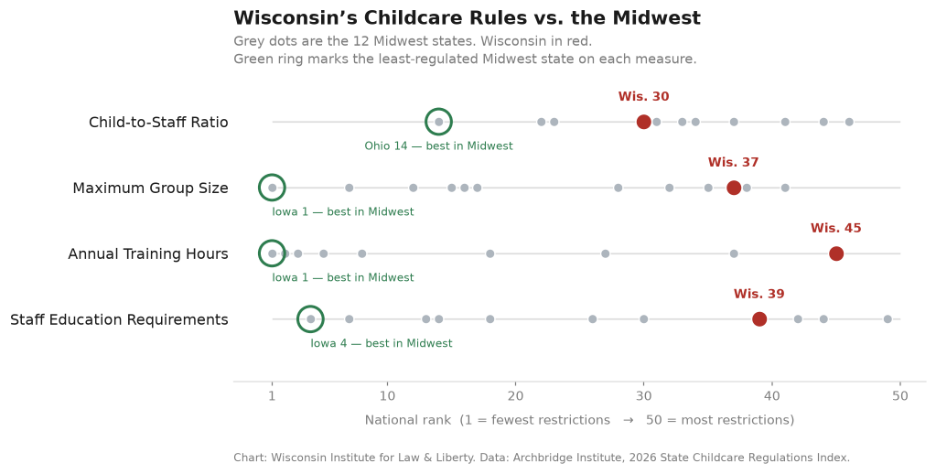
Wisconsin ranks in the bottom half of all 50 states on every measure the Index tracks: child-to-staff ratio, group size, training hours, and staff education. Among the 12 Midwest states, it finishes last.
Let Small Providers Grow: Act 15 created a new category of family childcare centers. The law directs the Department of Children and Families to license centers that serve 4 to 12 children. The previous family center limit was 4 to 8 children. The Department wrote the rule this year, and it took effect on August 1, 2026. A home-based provider can now care for up to 12 children with a second provider on site, instead of being limited to eight children. Group-center licensing, which is more heavily regulated, now starts at 13 children instead of nine. This new policy lets a small provider grow without jumping to a far more expensive and heavily regulated license.
Simplify Education and Licensure Requirements: A separate, widely cited study finds that increasing the education requirement for childcare center directors by one year is associated with a 3.2 to 3.8% reduction in the number of childcare centers. To direct a childcare center with 51 or more children, Wisconsin requires two years of experience plus eight credits in early childhood education. In contrast, Michigan requires a similar amount of coursework, but only three months of experience. As for teachers in a classroom, Wisconsin requires childcare teachers to have 240 hours of prior experience plus four credits in early childhood education, whereas Iowa’s licensing rules set no education or experience requirement for classroom staff. Responsibly reducing licensure requirements could lower barriers to entering the childcare workforce, making it easier to open and staff childcare centers.
Act 15 also lowered the age requirement for assistant childcare teachers. Now, the law allows a childcare center to hire an individual to be an assistant childcare teacher if the person is at least 16 years old and completes one of three training options within six months of starting.
Importantly, everything WILL proposes has already been tried and tested in other states. Wisconsin is testing some of these solutions right now. But these fixes can go further, and they need to be permanent.
Who Is Serious About Solving This?
The camp that only proposes throwing money at the problem without fixing what makes childcare limited and expensive in the first place is not serious about bringing costs down for Wisconsin families. To be serious about affordability, you have to be serious about addressing regulatory barriers that only add costs without any evidence of greater quality.
The good news is there are solutions on the table that will increase access to childcare and bring costs down. Wisconsin needs to increase group sizes, increase child-to-staff ratios, and make it easier for providers to enter the industry. Other states have led the way, and Wisconsin has fortunately taken baby steps in the right direction—but many of those changes will expire without action. If Wisconsin stays on course, gets serious about responsible deregulation, and makes reforms permanent, Wisconsin families will be better off for it.
The 2026 State Childcare rankings are compiled by the Archbridge Institute. The Archbridge Institute is an independent and non-partisan public policy think tank dedicated to fostering human flourishing through its research in economics and psychology.

Erin Gamble
Associate Counsel
Erin@will-law.org