
 Education


Executive Summary
Wisconsin is the birthplace of the modern school choice movement, with Milwaukee launching the nation’s first modern choice program over 35 years ago. In the decades since its creation, people have debated whether school choice produces better academic outcomes for students. Some studies have found benefits, while others have found little or no effect. One reason for these mixed results is that many studies do not account for the length of time a student spends in the program. Academic progress often doesn’t happen overnight, particularly with students who are often behind when they enter a private choice school.
This report addresses that concern, and, for the first time, answers the question: what happens when students stay in Wisconsin’s private school choice programs for several years? We gathered student-level data on more than 100,000 Wisconsin students between the 2018-19 and 2022-23 school years. Using established matching techniques, we compared students in private school choice programs (Milwaukee, Racine and Wisconsin) with similar students who remained in public schools. This is the first time such a study has been conducted on the Racine and Wisconsin parental choice programs. The results for the Wisconsin Parental Choice Program (WPCP) and Racine Parental Choice Program (RPCP) have undergone a rigorous peer-review process and were recently published in the Journal of School Choice. Similar research techniques were used to analyze the Milwaukee data, which is currently under review at an academic journal at the time of publication.
The key findings of this research are summarized in Table 1, which converts each program’s achievement gains into the equivalent additional years of public school growth needed to produce the same result. For example, after two years in the Milwaukee Parental Choice Program (MPCP), students, on average, would gain the equivalent of 1.35 more years of knowledge relative to a similarly situated student in a public school. While fewer years of school choice show no statistically significant effect, significant growth appears by year 2 in the MPCP and year 3 in the WPCP.
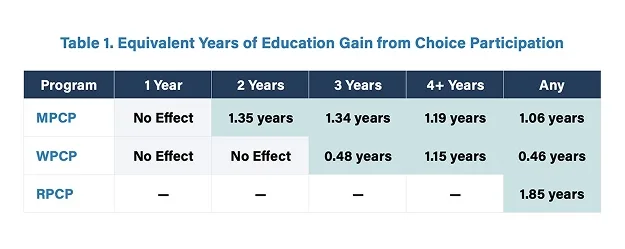
This data supports program expansion, not retreat. These findings undercut the case for winding school choice programs down. If anything, they argue for widening access — students who leave a choice program early, or never get the chance to enroll, may be missing the academic gains that only show up with time.
The findings were consistent across all three programs: students who stayed in school choice longer generally made larger gains in reading. The biggest gains appeared after students had spent several years in their new schools, suggesting that families and policymakers should not evaluate school choice programs based on short-term snapshots.
Why This Study Was Done
Wisconsin has one of the oldest and largest school choice systems in the country with nearly 60,000 students* across the three programs under study here, plus the Special Needs Scholarship Program. While Milwaukee’s program has been studied for many years, much less was known about the statewide and Racine programs. This research focused on academic growth rather than a single test score. Instead of asking who scored higher on one test, the study examined how much students improved over four years – and compared that growth to similar students who stayed in public school over the same time period. This approach provides a better picture of learning over time than a single snapshot can offer.
The Programs
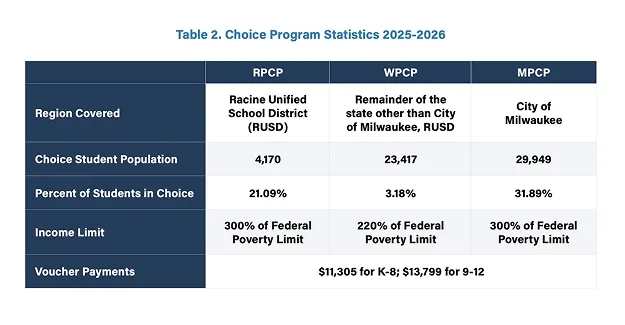
Wisconsin has three major private school choice programs. Milwaukee’s program began in 1990 and was the nation’s first modern voucher program. Racine began its program in 2011. The statewide Wisconsin Parental Choice Program began in 2013, allowing eligible families outside Milwaukee and Racine to participate. Some key statistics about each program are found in Table 2. Note that the data in this analysis are for 2018-19 through 2022-23 school year, but the information below is the most recent available.
How The Study Worked
The ideal test of the effectiveness of school choice programs would randomly assign interested families to either a choice school or public school, then compare outcomes. Practically speaking, this only happens in situations where there is more interest in the program than there are available seats, and lotteries are held to determine admission.
However, Wisconsin’s choice programs don’t operate this way broadly enough to allow for a lottery-based study. This creates a problem of selection bias — where specific characteristics of families who choose to participate in school choice might differ in important ways from parents who do not make that choice. For instance, if the families who take the affirmative action to remove their children from traditional public schools are generally more active in their child’s education than other parents, this could have spillover effects on academic outcomes unrelated to private school choice that would bias results.
Verifying The Results
To make sure these results weren’t an artifact of any single statistical method, we used other statistical models to verify our findings. These included a traditional regression analysis, and inverse probability of treatment weighting. Each approach produced similar conclusions. The overall message remained the same: longer participation in school choice was linked with greater academic growth.
We also tested whether the findings could simply reflect students staying in the same school longer. To test for this, we matched students with two or fewer years of school choice with students with three or four years of school choice based on their likelihood to have participated longer. This represents a tough stress test of the model because the “control” group participant base shrinks severely, but nonetheless similar conclusions were reached.
Discussion
Although the pattern of increasing benefits over time was similar across programs, the size of the estimated effects differed somewhat. Several factors could explain these differences. Milwaukee’s program is older and serves a different student population along economic and racial lines than the statewide program. Students entering the programs may differ in prior educational experiences, participating private schools may have different instructional models, and local education markets vary substantially across Wisconsin. Because the purpose of this study was to estimate overall program effects rather than identify the mechanisms behind them, additional research would be needed to determine why impacts vary across settings.
Important Limitations
Because families choose whether to participate in school choice, researchers cannot completely rule out differences that cannot be measured, such as parental motivation or family involvement. The study also took place during and after the COVID-19 pandemic. Private and public schools often responded differently during this period, with private schools being more likely to reopen sooner.*
For these reasons, the findings should be viewed as strong evidence of a relationship between school choice participation and student achievement growth rather than absolute proof that school choice alone caused every improvement in every context.
Conclusion
Previous research on Milwaukee’s voucher program found positive long-term effects on reading achievement after students had spent several years in participating schools. The present study reaches a remarkably similar conclusion using more recent student-level data and extends those findings to Wisconsin’s newer choice programs. These analyses suggest a consistent pattern across multiple cohorts and multiple regions of the state. The recurring finding across all three parent choice programs — that benefits increase with time — strengthens confidence that the relationship is meaningful rather than a statistical anomaly.
This is also the first comprehensive, peer reviewed analysis of school choice programs in Wisconsin outside of Milwaukee. Education reforms are often judged too quickly. This 9 A Matter of Time Conclusion research suggests that patience matters. Students may need several years in a new school before the full academic benefits become visible. For families, the findings suggest that changing schools should be viewed as a long-term decision. For policymakers, the results suggest that evaluating programs after only one year may underestimate their impact.